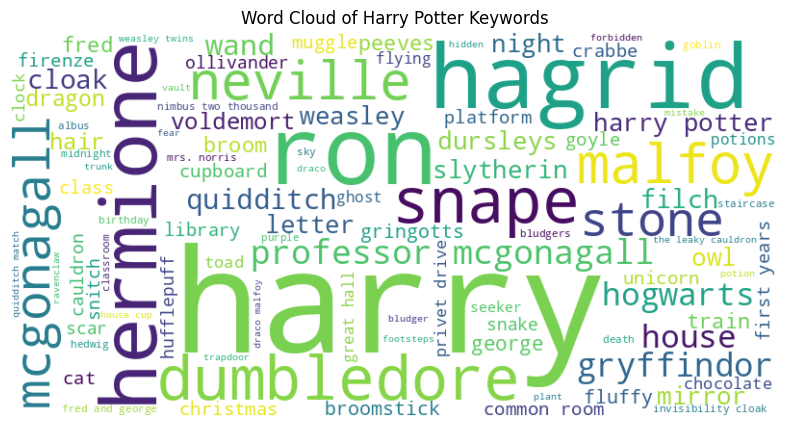
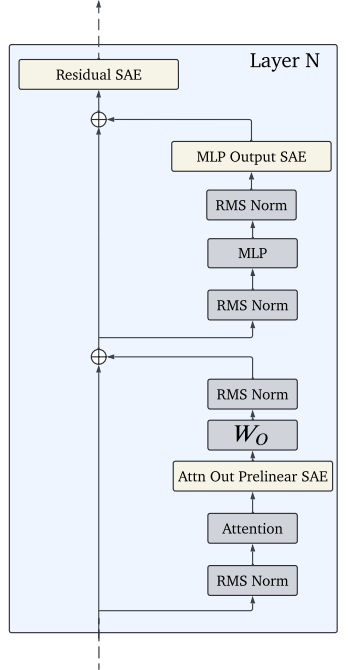
Left: Harry Potter keywords used for feature search. Right: SAE locations in a Gemma 2 layer. This project uses the residual SAE. Diagram from Lieberum et al., 2024.
Setup: Gemma-2-2B, Gemma Scope residual-stream SAEs (16k width), [TransformerLens](https://github.com/TransformerLensOrg/TransformerLens) and [SAELens](https://github.com/jbloomAus/SAELens). ## Results Perplexity on 1,000 samples per dataset. A good unlearning result raises perplexity on the Harry Potter text and keeps it low on WikiText-2. | Setting | WikiText-2 | WikiText-2, keywords removed | Harry Potter Book 1 | |---------|-----------:|-----------------------------:|--------------------:| | No ablation | 17.93 | 18.37 | 26.94 | | Layer 0 ablation | 283.47 | 284.02 | 243.55 | | Layer 12 ablation | 52.98 | 54.14 | 137.55 | | Layer 25 ablation | 38.50 | 39.19 | 46.45 | Generation samples show the same pattern. After layer 12 ablation, "Who is Harry Potter?" still gets an answer about a fictional character. The answer loses the specifics and starts to repeat itself. ## Limitation The hook replaces the residual stream with the SAE reconstruction. Some of the perplexity increase therefore comes from reconstruction error, not from the ablation. We did not measure a reconstruction-only baseline (the SAE with no features set to zero). That baseline is the first control to add. ## Repository layout ``` notebooks/gemma2_2b_unlearning.ipynb Full experiment: baselines, feature search, ablation, evaluation data/keywords.txt Harry Potter keywords for feature search and text cleaning data/top_features_by_layer.txt SAE feature IDs returned by NeuronPedia, by layer figures/ README figures and the scripts that draw them site/ Source of the expo report page ``` To redraw a figure, run `python figures/make_perplexity_figure.py figures/perplexity_ablation.png` or `python figures/make_method_figure.py figures/method.png`. Both scripts need only matplotlib. ## Run the notebook The notebook runs in Google Colab on an A100 GPU (40 GB). 1. Install `transformer_lens` and `sae_lens`. The first cell does this. 2. Set `HF_TOKEN` as a Colab secret. Your Hugging Face account needs access to `google/gemma-2-2b`. 3. Set a NeuronPedia API key (from https://www.neuronpedia.org) before the feature-search cell: ```python import os os.environ["NEURONPEDIA_API_KEY"] = "..." ``` 4. Supply your own plain-text copy of *Harry Potter and the Philosopher's Stone*. The book is copyrighted, so this repository does not include it. The notebook reads the book and `keywords.txt` from `/content/drive/MyDrive/Unlearning/`. Copy both files there, or edit the paths in the data-loading cell. ## References - Lieberum et al., 2024. *Gemma Scope: Open Sparse Autoencoders Everywhere All At Once on Gemma 2.* - Eldan and Russinovich, 2023. *Who's Harry Potter? Approximate Unlearning in LLMs.* - Cao and Yang, 2015. *Towards Making Systems Forget with Machine Unlearning.* - [NeuronPedia](https://www.neuronpedia.org), for feature explanations and search.